






In this column, we’re looking back at the 1980s as their own particular age of fantasy movies—a legacy that largely disappeared in the ’90s only to resurface in the 2000s, though in many ways, the fantasy films of the Eighties are far weirder and less polished than what we got in the aughts. In each of these articles, we’ll explore a canonical fantasy movie released between 1980 and 1989 and discuss whatever enduring legacy the film has maintained in the decades since.
For a more in-depth introduction to this series of articles, you can find the first installment here, focusing on 1981’s Dragonslayer. Last time we looked at one of Disney’s animated flops, the Welsh mythology-adjacent The Black Cauldron. This time, we are diving into the very heart of Welsh mythology with John Boorman’s capacious retelling of the Arthurian saga, 1981’s Excalibur.
I hadn’t seen Excalibur until I watched it for this column, though I had seen bits and pieces of it on cable over the years. My overwhelming impression of the film, prior to this viewing, was that it was blindingly glittery—a notion that has not been dispelled by my more recent experiences. That said, I have been, since college, a huge fan (albeit with a large helping of irony) of director John Boorman’s earlier film, Zardoz (1974) which gave us countless Giant Flying Head memes and the single best costume Sean Connery ever donned.
Excalibur is a fairly straightforward retelling of the Arthurian legend, drawing on Thomas Malory’s Morte d’Arthur and T.H. White’s The Once and Future King and throwing in a heaping helping of camp and perhaps just a soupçon of LSD. It covers the circumstances of Arthur’s birth with Uther Pendragon’s deception of Igraine and then moves through most of the major story beats: pulling the sword from the stone, his marriage to Guinevere and her subsequent infidelity with Lancelot, the quest for the Holy Grail, Arthur’s death at the hands of Mordred, and his body being sent out to sea towards Avalon.
There are key changes made in order to streamline the story: the titular Excalibur is the same blade as the Sword in the Stone in this version of the legend (they are separate swords in most early accounts), Morgan le Fay and Nimue have been combined into a single character, Perceval returns to being the chief grail finder after Malory and White cast Galahad (Sir Not-Appearing-in-this-Film) for the role and also replaces Sir Bedivere as the knight who returns Excalibur to the Lady of the Lake. Throughout all of this, everything appears very sparkly and very jewel-tone green.
The film was largely well received by critics and was nominated for a number of awards (including an Academy Award nomination for cinematography) but didn’t win any major awards. It has a reputation, now, as a deeply flawed but visually stunning film by a talented director. But is that reputation earned? How does Excalibur hold up forty-five years after it first premiered?
The film’s reputation is not too far off from my experience of watching it. It certainly is a visual feast, filled with sumptuous costumes, huge battle scenes, and striking cinematography. Boorman’s storytelling is lyrical and dreamlike, with sequences that might insinuate magic or hallucinations or simply gesture toward metaphor. Overall, the sweeping scope, bold visual choices, and the emphasis on the magical and dreamlike has caused more than one person I know to remark that it feels like the text that Monty Python and the Holy Grail is parodying, despite the fact that the comedy came out six years before Excalibur was released.
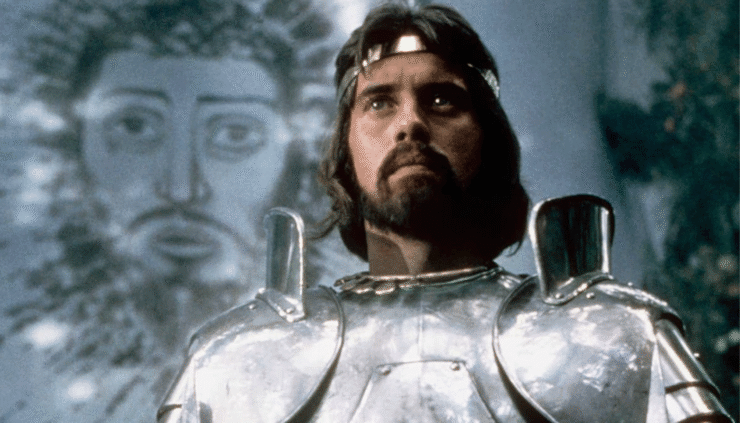
That said, the film has more than its fair share of flaws, shortcomings, and inscrutable choices to keep it from being a true masterpiece. Let’s start with Arthur himself. Played by Nigel Terry (who I know best as John, the deeply unlikable third son of Henry and Eleanor in 1968’s The Lion in Winter), Arthur isn’t particularly charismatic or clever or handsome or anything that you might want or expect in the lead of your extravagant cinematic adaptation of Arthurian legend. Arthur, instead, comes across as mostly befuddled throughout the film—a fact not helped by Terry giving him (at least when he is meant to be a teenager) a West Country accent to reflect the “historical” Arthur’s Cornish origins. Which means that for the first third of the movie, he sounds exactly like Samwise Gamgee in Peter Jackson’s Lord of the Rings.
I don’t want to fault Terry as an actor. He is talented and clearly making choices that feel consistent with the rest of the film. But he works best as a character like the aforementioned Prince John, and the older Arthur is styled in such a way that reads as “evil vizier” or “sniveling henchman” rather than kingly. More than anything, he resembles Sean Whalen in the classic 1993 “Aaron Burr” Got Milk? ad. If this were consistent with the take that Boorman is putting forward, it might have been interesting—Arthur as antihero—but instead it always feels out of place: a strange void at the center of the film.
When combined with Nicol Williamson’s arch, campy turn as Merlin, it sets the stage for some wildly inconsistent tonal shifts from scene to scene. Williamson, who played Sherlock Holmes in The Seven-Per-Cent solution (and would go on to give a similarly campy turn in Return to Oz, previously covered in this column) is one of the most entertaining presences in the film: droll, long-suffering, and willing to use magic to be just a little bit petty and mean. He leans into physical comedy, pratfalling in a river, bugging out his eyes while intoning “a dream to some, a nightmare to others!” while spreading his arms wide and unceremoniously disappearing from the frame. Merlin’s numerous scenes matching wits with Morgana (played by a young, sultry, always gorgeous Helen Mirren) are among the film’s best. But, again, he’s a cranky comedy Merlin, wielding a staff with a blowtorch attached to the end of it and rolling his eyes at the clueless young Arthur. Williamson is perfect for the role—which is made all the more surprising by the fact that Boorman had originally wanted to cast Lee Marvin, Sean Connery, Max von Sydow, or Klaus Kinski.
The film unfolds against a backdrop of strange and puzzling choices. The opening title font is called “Herkules” and looks like it belongs in the Cheers title cards. Camelot has an oddly modern look, as though it is composed of stainless-steel blocks—anachronistic to any and every time and place. When Lady Igrayne (played by Boorman’s daughter, Katrine) dances for the guests of Lord Cornwall, she gyrates wildly with moves that feel like they would be more at home in a mid-’90s goth club. When Uther perfidiously seduces Igrayne, he never removes his plate mail, leading to one of the most improbable and preposterous sex scenes in all of cinema. Carl Orff’s Carmina Burana plays multiple times, and each time it feels like a shocking intrusion into the film, starting well into the crescendo of the piece.
Occasionally these choices are striking and cool: Mordred wears armor that includes a profoundly creepy golden mask; Lancelot, fled from Camelot after Guenevere’s trial, becomes a bearded, zealous hermit; Perceval spends long years searching for the Grail in ever-trippier sequences of repeated journeys to repeated castles. Those moments are fascinating, but they are too few and far between in the midst of this sparkly, green-tinted fever dream that, more often than not, is too deeply odd to feel truly epic.
As to Excalibur’s legacy in the years since, it has certainly had a potent influence on certain films and filmmakers. Famously, former DCU head and Man of Steel director, Zack Snyder, named Excalibur as his all-time favorite film. You can see Boorman’s penchant for anachronistic sets and costumes influencing the look of later Arthurian tales like 1995’s First Knight and 2004’s King Arthur (despite the fact that the latter was billed as an “historically accurate” retelling of the legend). You can see the same love of blending the legendary and hallucinogenic in Arthurian films like The Green Knight (2021) and King Arthur: Legend of the Sword (2017). It may postdate Monty Python and the Holy Grail, but for its many fans, Excalibur has become the definitive Arthurian adaptation.
The film also served as a fascinating launching point for a number of prestigious careers: Gabriel Byrne, in one of his first film roles, plays Uther Pendragon; Liam Neeson, in his second film role (before Krull, even!) and sporting incredibly unfortunate facial hair, plays Sir Gawain (in the role of Guenevere’s chief accuser, with nary a Green Knight in sight); Patrick Stewart, though already an established stage actor and a staple of ’70s BBC miniseries like I, Claudius and North & South, has a fairly large supporting role as Leodegrance, Guenevere’s father; and Ciarán Hinds, in his first widely distributed movie, plays King Lot. In that regard, the films stands as something of a watershed moment in establishing the current generation of British actors who’ve matured into the elder statesman of stage and screen.
But what do you think? Is Excalibur as flawed as I’ve made it out to be? Are you a fellow Nicol Williamson stan? Do you think you could have bought a house with the amount of money the production spent on green gels for their lights? Let me know in the comments, and be sure to join us next time when we move from sword and sorcery at its most highfalutin to sword and sorcery at its cheapest and sleaziest with the Roger Corman-produced Sorceress (1982)!

The thing I remember most about Excalibur (besides Merlin feasting on the scenery) is just how shiny it is. It basically has all the lens flare.